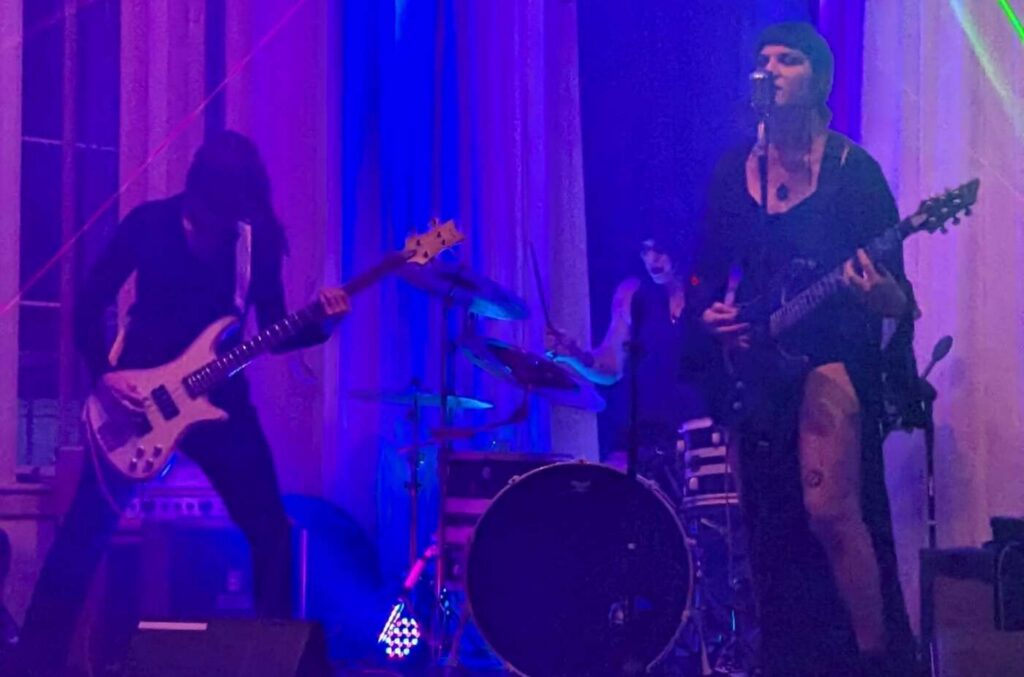


Last year, a new festival held their first event in the Bay Area in California. Doll Fest describes itself as “a celebration of the feminine energy, friendship, and community gathering together in support of one another.” This year, Doll Fest is back! Volume II will be held THIS WEEKEND in Oakland, CA on March 28th and 29th with a pre-party on the 27th. And the lineup this year is just as jaw dropping and inspiring as the last.
We wanted to get in on the action, so we’ve asked the amazing bands a handful of questions about the festival including who they’re stoked to be playing with and what they think a festival of this caliber means to our scene.
We spoke with Alice, Dolly, and Kitty of Wonderland Rejects about amplifying femme voices, taking up space as a form of activism, and how Doll Fest feels like a powerful sign that the scene is changing for the better. They also reflect on trans visibility, riot grrrl energy, and carrying forward a legacy of artists who refused to stay silent in the face of misogyny and transphobia. Check out the interview below and grab your tickets to Doll Fest today!
Interview

What does playing a femme-only festival like Doll Fest mean to you personally?
Alice: It’s very significant being part of an event this size, that amplifies femme voices and art. So many femme punk/rock artists inspired me when I was growing up, so being able to carry on that legacy means a lot.
Dolly: It means times are changing for the better.
Kitty: What it means to me is being in good goddess energy and showing the patriarchy that we are not silent and we will be heard by all those that need to hear artists like ourselves.
How does playing a festival like this shift the energy—on stage or in the crowd?
Alice: The size of the crowd can play a big part in the overall energy of the show; i.e. larger crowds usually being more energetic. But, at the end of the day, the show is what we make of it; whether there’s 10 people in the audience or 100, we give it our all.
Dolly: Events like Doll Fest shift the energy away from white cis male centered scenes; giving femme artists more opportunity.
Kitty: The energy on the stage and in the crowd feels more connected with the riot girls inside all of us; essentially weaving an etheric bond with all those playing and all those listening and getting lost in the moment.
What would you want a younger version of yourself to feel seeing this lineup?
Alice: I would hope younger me would learn to lead by example and to never give up on my dreams nor my identity, no matter what anyone else had to say.
Dolly: I would want a younger version of me to be proud and know that it’s okay to pursue music.
Kitty: I would hope little girl me would see hope and to never give up through any darkness.
What does “taking up space” look like for you as a femme musician?
Alice: As a femme musician, I look at ‘taking up space’ as a form of activism. In a lot of these scenes, femme, BIPOC, and queer artists are conditioned to ‘not make waves’ or be ‘too much.’ while white cis male artists are encouraged to be bold, and all too often given a pass for unprofessional behavior. As a femme, taking up space (in male dominated spaces) means unabashedly saying ‘I’m proud of who I am and I belong here.’
Dolly: For me, it means going after my dreams regardless of the consequences.
Kitty: I hope I make all the legends that carved this path proud.
Who are some femme artists—past or present—who have inspired you or paved the way?
Alice: I take a lot of inspiration from the women of the early 20th century Blues era, such as Sister Rosetta Tharpe, Memphis Minnie, Billie Holiday, Bessie Smith, and Big Mama Thornton who all battled both racism and sexism, while getting little to no credit for their work and the indelible impact they left behind. I feel they’re all the OG Riot grrrls.
Dolly: Joan Jett, Alanis Morissette, Pat Benetar, and Memphis Minnie.
Kitty: Ariel Bloomer of Icon for Hire; a lot of her words in so many songs have seen me through some really rough spots. Another artist is Mercedes Lander of Kittie. She is absolutely fierce and such an inspirational woman and drummer.
How does your identity influence your music, performance style, or the stories you tell?
Alice: I write a lot about the femme condition, finding ways to thrive in a world built for white straight cis men. I’ve gotten criticized by guys for not being conventionally attractive enough, that I’m not traditionally feminine enough to ‘pass’ as a trans woman. So, the way I look at it, my presence is a constant act of defiance to those archaic ideas, while also showing other femmes that it’s okay to not fit the beauty and gender standards set by folks who wanna keep us divided to maintain their power.
Dolly: I put all of my experiences into my music.
Kitty: My identity can come off as dark, brooding, and sometimes mysterious. This allows, in my mind, the ability to float through so many styles of drumming and find the drum patterns that best honor the song at hand.
How does your lived experience show up in your lyrics or live performance?
Alice: As someone who has experienced a lot in life, I put a lot of that into the songs I write. While I write about some of the heavy stuff I went through, as well as my own mistakes, I especially enjoy writing about the things that got me through the hard times, and what I learned from it all. I live my life under the principle of being 1% better everyday, I put that into my playing, my song writing, and how I conduct myself in front of fans, peers, and detractors alike.
Dolly: My lived experiences show up in my performances, as I get lost in the music.
Kitty: I was a fantasy painter for years. When I drum I paint notes with my sticks and the skins are my canvas.
What is one local or regional band near you that you want the whole world to know about and want them to play Doll Fest?
Alice: The Lillies; they’ve got a great sound and we always love sharing a bill with them
Dolly: The Lillies
Kitty: The Lillies, cause they shred!
Have you experienced moments where being a femme artist shaped how you were received in the music scene?
Alice: Early in my career, I encountered a lot of misogyny and transphobia, primarily from male musicians (other femme artists on the transphobia front). In the best case scenario, I’d get brought into projects to be a novelty hire, where they could label themselves “progressive” just because they hired a woman; treating me with little to no respect, and most of them didn’t credit me for my work. In the worst cases, I’d deal with guys wanting to work with me just to get into my pants, and then fire me out of spite when I said no. Or, if they knew I was trans, lean heavily into transphobia when I didn’t give them what they wanted.
On top of that, I encounter so many guys who assume I don’t understand the nuts and bolts of the music business, such as gear maintenance, sound engineering, and show production, despite my having experience with all of it.
Dolly: Some people have given me a hard time for being trans.
Kitty: This was a tricky one to answer. On one hand I have made so many new friends over the last couple of years but being trans I sometimes deal with weird misogyny and weird under the breath transphobia. I think there are a lot of folks in the scene that need to look inward and get their hearts right.
Post a comment